Authorise urgent security fixes in advance, remove repeated customer approval and UAT waits, and make minutes or hours the target for reaching production.
A security update is available. Your provider raises a ticket and waits for permission to start. After preparation and testing, it waits for customer user acceptance testing (UAT). Then it waits for production approval and the next release window.
A short technical task can become days or weeks of elapsed time. Throughout that process, the live website may still be running the vulnerable software.
For critical security fixes, that approval model needs to change. Customers should authorise their provider in advance to begin immediately and deploy as soon as the agreed release checks pass, without another customer approval or UAT cycle.
AI has changed the time available to respond
ASD's guidance on AI-enabled cyber attacks warns that AI enables vulnerability discovery and exploit development within hours. It calls on executives to accept more operational risk from rapid remediation and recommends automatic patching where failure risk is acceptable or recovery is straightforward.
The response window may already have closed when a fix arrives. ASD's latest threat report describes exploitation occurring before a vendor releases a patch. In those zero-day situations, containment or mitigation may be needed first. Once an applicable fix exists, a customer approval queue adds further exposure.
An urgent security process cannot depend on having several quiet days after disclosure. Stakeholders need to acknowledge that and change the decisions that keep a ready fix waiting.
Give the instruction before the emergency
The customer and provider should agree a standing instruction along these lines:
For an eligible critical or actively exploited vulnerability affecting our production service, begin remediation immediately within the agreed scope and budget. Once the agreed release checks pass, deploy without waiting for further customer approval or customer UAT. Notify us when work starts and when production remediation is verified. Escalate failed checks or changes outside scope immediately.
That instruction authorises both the work and the production release. Approval to spend support hours alone is insufficient.
Agree the covered sites, update types, spending limits and technical release conditions. Name the people who can pause the process or resolve an exception. Make the authority part of the service agreement and the organisation's approved change process.
Notification should provide visibility while the work proceeds. An email asking the customer to acknowledge the update before deployment would recreate the same delay.
Move customer UAT out of the urgent patch path
For eligible urgent security updates, a fresh customer UAT cycle should not be the default release gate.
Agree the important business journeys and acceptance checks beforehand, and build repeatable testing around them. When the update stays within the authorised scope and the required checks pass, the provider can release it.
Changes that introduce new business behaviour, require a major upgrade or fall outside the agreed conditions need an exception decision. Those cases should go straight to a named responder, with mitigation considered immediately. They should not quietly join the normal maintenance queue.
Any technical review that remains required needs prompt access to a qualified reviewer. Otherwise, removing the customer's queue simply transfers the delay to the provider.
Make the release decision about both risks
A deployment can fail. Delaying a security fix also leaves the service exposed. The customer must decide in advance how those risks should be balanced for urgent remediation.
For covered critical fixes, the agreement should authorise release outside routine maintenance windows when the required support and recovery arrangements are in place. Friday rules and change freezes need an agreed emergency route.
Specify recovery actions and who owns them. If a rollback restores the vulnerable version, the security work remains open and needs immediate follow-up.
Include PHP and other underlying software in the arrangement. Name the application or hosting team responsible for each component so a runtime update does not disappear into a separate approval queue.
This is what makes automation useful
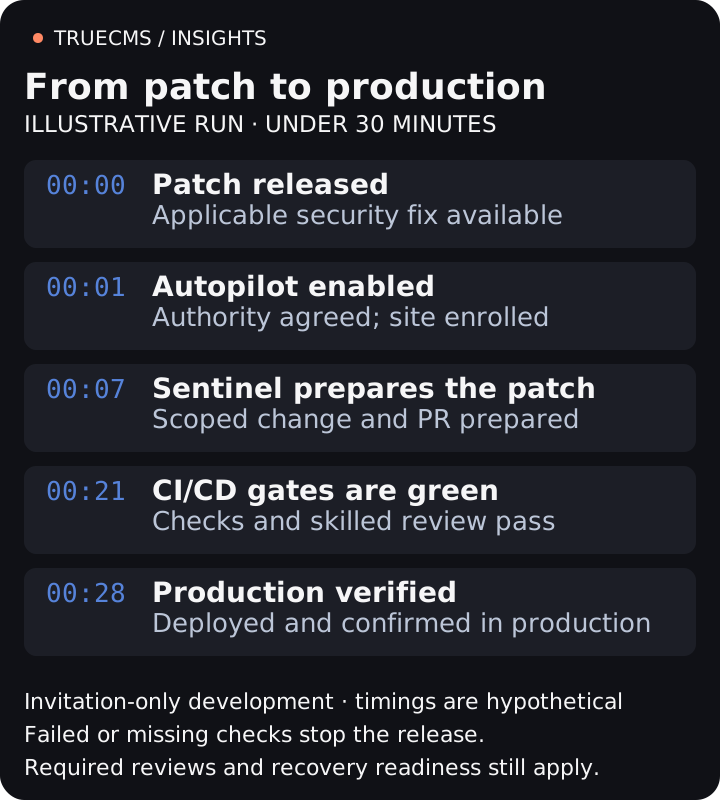
Illustrative target workflow, not a measured result or guarantee. Autopilot is in invitation-only development. Required reviews, customer authority, support and recovery arrangements remain release conditions.
Once authority is settled, automation can prepare the update, run the agreed checks and carry an eligible change through the release process. The elapsed time can then be dominated by the build, tests, deployment and verification.
That creates a practical route from days or weeks towards minutes for suitable updates. Where the technical process takes longer, design for hours. These are response targets; the actual time depends on the change, the site's release process and whether its checks pass.
This is the model behind the automated patching service TrueCMS is developing alongside Sentinel Connector. Its Autopilot mode is designed to merge and deploy eligible security updates under agreed rules. Access is invitation-only while the service is being built and tested.
Customers can establish advance authority now, including where their provider still performs some technical steps manually.
Measure the time until production is fixed
Measure from an applicable security update becoming available to verified remediation on the live service. Keep technical work and waiting time visible. A missed response target should trigger an urgent exception, with an owner and a next action.
Ask your provider one direct question: if a critical security fix becomes available today, are you already authorised to start and deploy it?
Talk to TrueCMS about your urgent security patching process. Agree the authority, checks and response target now, so the next security update can proceed as soon as it is ready.